
Three Towns – 7 July 2025
Edinburgh
I have been on this train many times, from Edinburgh to London. The day after my wedding, with friends and beers and card games, masked post-pandemic, after New Year’s 2023 when we decided to try to have a baby, with that baby as a baby, and now with that baby who is almost two. I look for ways for time passing to make sense, and to note how I have changed.
North Berwick
We walk along the coast, tracing coves, tide pools and shoreline. We talked about work and friendship, unpacking stresses as we picked along the path. The North Sea looks dark and cold, the sand warm and inviting in the unexpected sun. I burn on both arms.
Dundee
Acts of Creation at Dundee Contemporary Arts.
An unexpected well of sadness.
Overexposed.
Birth feels so long ago.
I don’t like what’s happened to my breasts, long and empty. Sometimes I find curdled milk in my nipples, sometimes I feel a phantom squeeze that tells me milk is coming.
The detailed journal entries from a young mother, I am bored. Unlike my journal entries, which are fascinating.
Sterile museum, wildness confined to the border of a frame or a canvas.
Why does it make me sad?
There is challenge in the time, loneliness, pain.
It’s refereshing to see the startled faces immediately post-birth, bodies messy, stretched and wrinkled. Breasts and nipples and pubic hair and scars. Bellies.
But it’s hard. I feel exhausted thinking back to being exhausted and overwhelmed and freshly shattered.
Where’s the joy?
There’s a table with a tiny baby. The baby has a tube coming out of its nose.
I am cast back to when I had a tiny baby and other mothers with older kids would look at me wistfully, and I didn’t really know what it meant.
Cemetery People – 3 August 2025
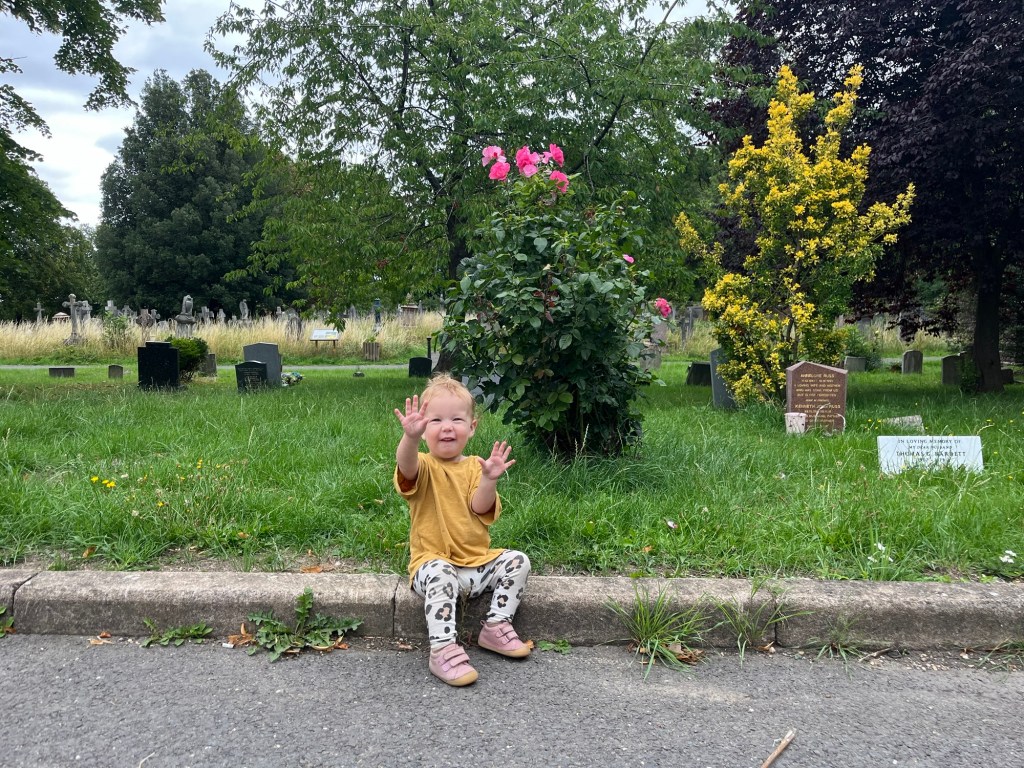
We took a family walk through the cemetery.
There was an older woman sitting on a bench with three full plastic bags, plus one big blue IKEA bag. She was wearing a sun hat and writing in a small notepad. There was the family of four eating sandwiches in silence. A Dad and his young son doing laps. Many parent-child combinations, of all ages. An older couple dressed all in white apart from the hot pink sweater around the shoulders of the woman.
We come to the Crematorium. I once read a book by a woman who worked in a crematorium in San Francisco. There weren’t many women in the field. I learned about embalming and the bureaucracy of collecting a dead body and other things I’d never really thought about before.
Luna is eager to get out of the pram and walks alongside us. She is thrilled to be joining in on the actual walking of this walk. Her small frame and oblivious delight bounce along in stark contrast to our surroundings.
We passed a mound of dirt next to a hole with odd planks of wood covering it. Tucked into a corner close by was a small excavator next to a rectangular plot covered in new-ish flowers. As we passed, a car pulled up to the side of the road and a woman in athleisure wear got out of the driver’s seat with a bouquet of flowers. She wove through the rows of headstones until she reached the patch of land we had been watching. She seemed to be moving efficiently, but then bent over and started grabbing fistfuls of crunchy leaves and redistributing them outside the plot. We walked on at the pace of our nearly two year old and when I looked back, she was still on her knees clearing the leaves away.
“Tooooms” “gaaaaaaves”, “semetayyyy” Luna repeats.
I listened to a podcast several years ago about talking to children about death. About how it’s important to be clear in your language, saying “dead” and “died” instead of euphemisms like “isn’t with us any more” or “passed away” which can be more confusing. She spoke about how explaining the biological reality of how someone’s heart has stopped beating, or their brain has stopped working is helpful for a child’s logical mind, and is actually less scary than a more vague alternative. This made sense to me, it’s what’s really going on. I understand the impulse to shield them from this unpleasantness, children are the antithesis of death, literally new life. But they are curious and they are smart, it is a part of life, and may be a part of their life.
A Shag – 9 September 2025
Last night, we had sex for the first time since July. PSA to the family members reading: this is about sex.
Sex is funny because it’s happening all around us, all the time, but we don’t talk about it very much.
Having a baby is funny because of how much joy and attention you and your body receive, but how the instigating event – a shag, or even a long period of repeated shagging – while known to all, remains unspoken, except for maybe a quick nod and a twinkle in the eye.
Of course, there is beauty in the intimacy of the experience shared between you and your partner. So much of our lives are now broadcast, maybe this is the last area of life that remains truly private. Unless you write about it on a blog.
I am prompted to think about this as we slowly rebuild a sex life after having a baby. This experience is largely absent from the postpartum literature I have devoured, when trying to make sense of this mad upheaval of self and life. When does it feel good again? Will it ever feel good again?
Pregnancy, birth and breastfeeding demand you have a different relationship with your body. After my vagina was shredded, sex was naturally off the cards for a long time. At my first appointment five days after the birth, midwife Kayla asked me what my contraception plan was and I stared blankly for several silent seconds, not sure I had heard her correctly. Um, abstinence?
The first time we tried to have penetrative sex was four months after the birth. It was immediately too painful so we stopped. We tried again at five months and it was still too sore. We tried again at six months and it was not painful, but it was not pleasurable. A neutral shag – this is as romantic as it sounds.
A period away from sex with your partner means that when you come back to it, you’re kind of discovering each other’s bodies again. Just noticing what feels good. Not rushing. Slow, intentional, awkward, nice physical intimacy that gets better over time is not just absent from postpartum literature, but most depictions of sex.
 Junk Drawer
Leave a comment