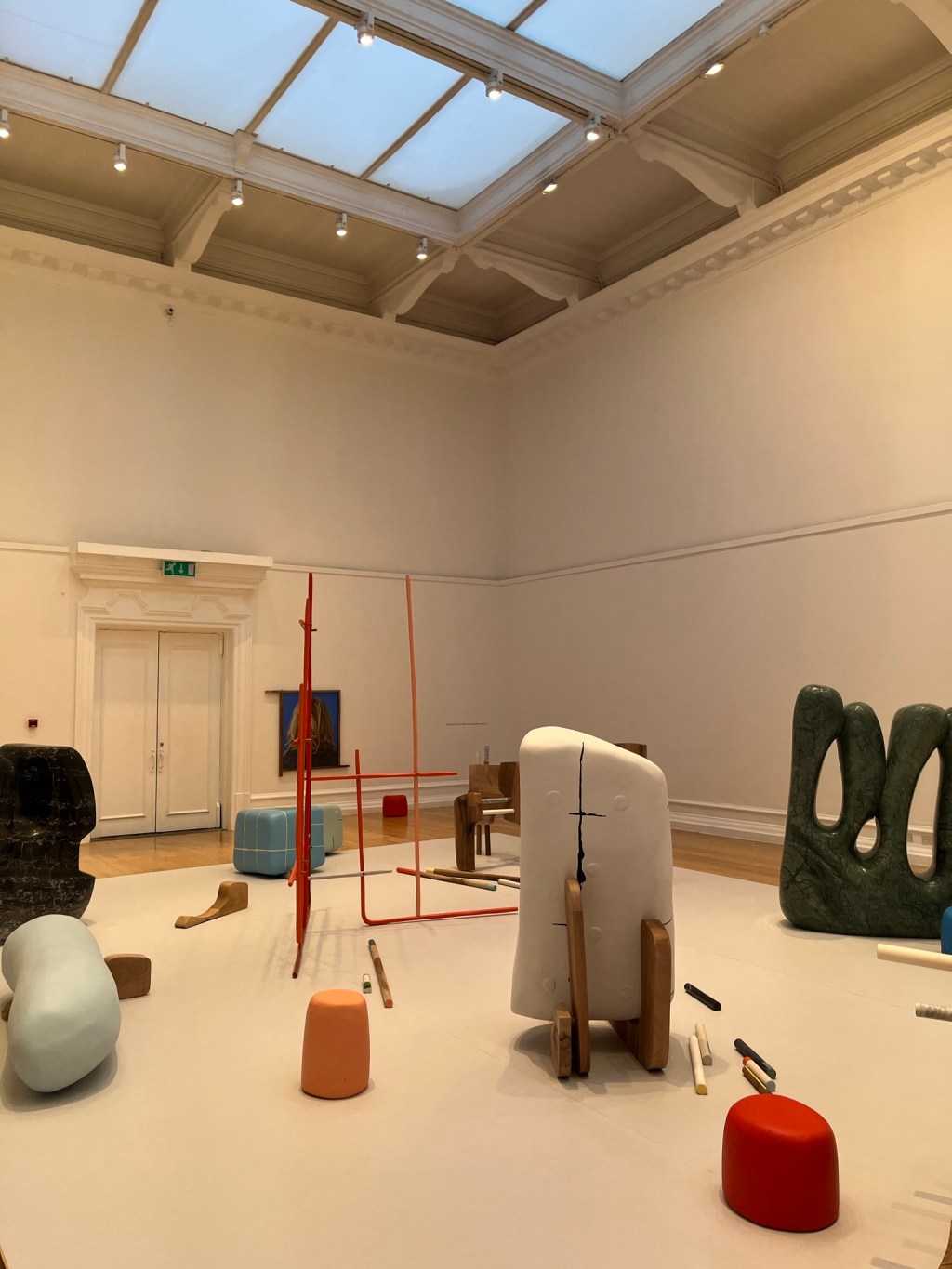
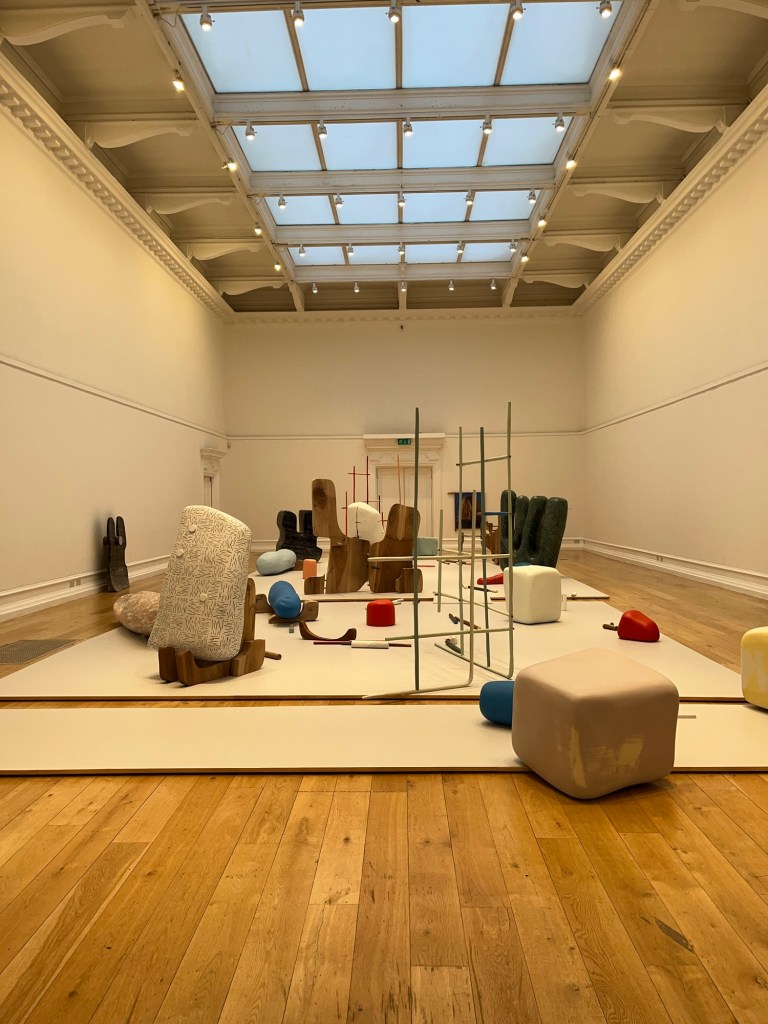
The current installation in South London Gallery’s main gallery is not for touching. It takes over most of the space, leaving just a rectangular path around the outside. On the floor, a series of connected wooden boards are painted white. Scattered on top of this foundation are various three dimensional shapes. Thin, incomplete lattice structures, rising unfinished into space and thick blobs in bright colours look like giant play dough shapes. Varnished wooden stands prop up some of the play dough creations, but some stand empty, one wooden structure stands assertively in the centre as its own sculpture. A few larger shapes come in different speckles of marble and painted patterns. Luna looks at the scene and crunches on a veggie straw as we walk around the rectangle. The bright colours must pop against the stark white backdrop. She looks between the art in the room and the light coming through the windows on the ceiling.
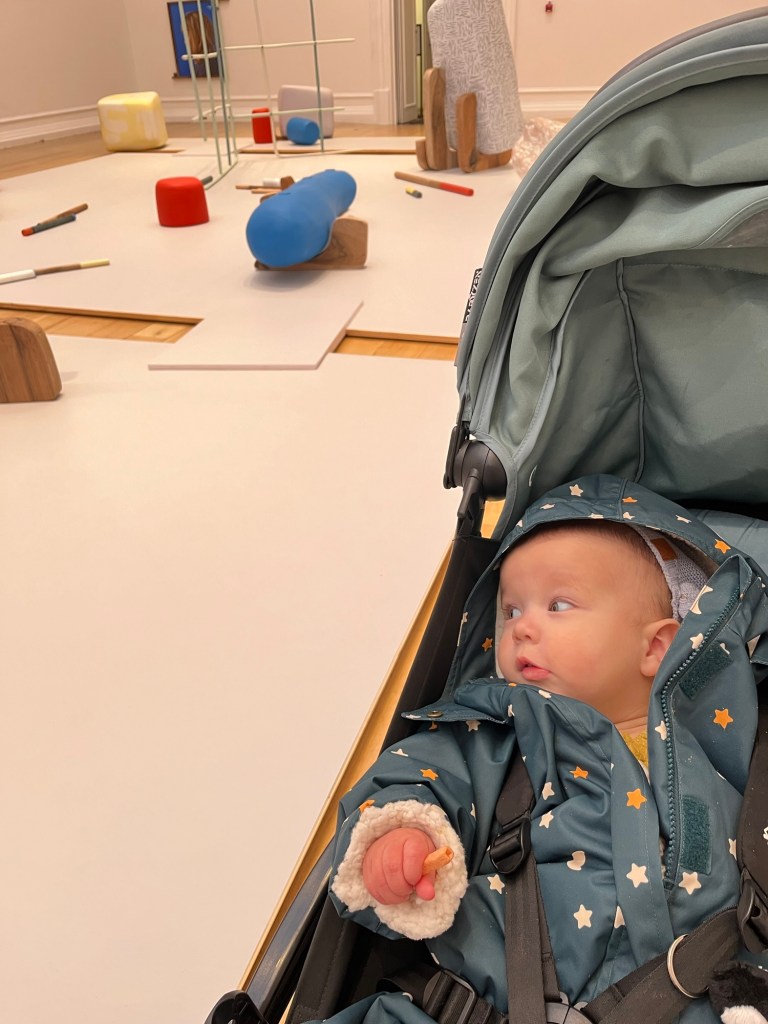
Being in the world with a baby has made me see many things with fresh eyes, imagining the sensory experience Luna might be having. This is especially the case with art. I wonder what she sees. So I break what I’m seeing down into its simplest, component parts, imagining the bits that might stick out to her. I notice what they make me think about. I notice how I feel.
The colours of each object are vivid and draw me in. The textures are smooth, with rounded edges and the shapes have a satisfying weight and substance to them. They make you want to look at them, to run your hand along them. In between the larger pieces, there are bits of debris that look like leftover scraps of the different materials in use. This landscape looks different from every vantage point. These pieces could be rearranged in any way, the play dough could be reshaped or added to. It feels like a room in progress. It would make a great set, each element beautiful and intriguing on its own, but full of potential energy, ready to be manipulated in unexpected ways.
I’ve always been drawn to visual art, and seek out art museums wherever I go. But part of me has always been a little preoccupied with what thoughts I should be having while I’m viewing. What’s the sociopolitical context, how does this fit into the artist’s larger body of work, what contribution does it make to the world? I read the blurb to find an answer, but usually find the academic explanations too dry to absorb. I feel I should, but don’t, have anything smart or original to say.
At the same time, I want to disrupt the shushed reverence for the pristine gallery space. We’re just walking in circles around silly shapes! That one looks like a blue penis! Why are we being so serious! But the quiet is calm and it does feel special in here and we need a place that can inspire and hold all these different meanings.
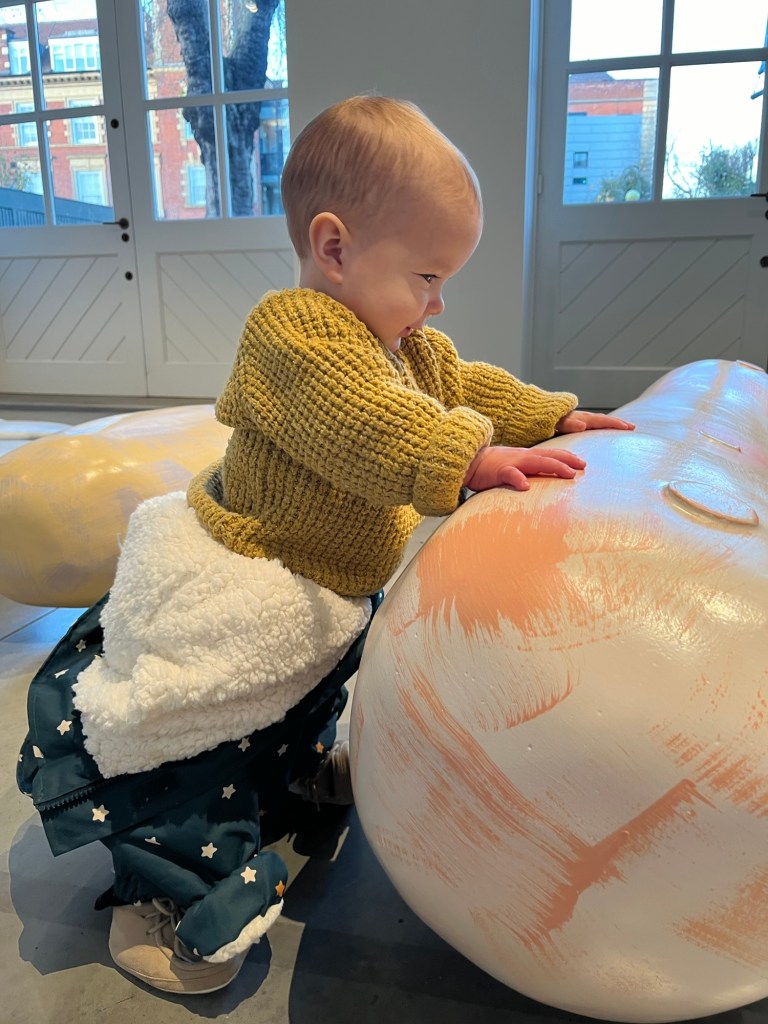
The installation in the fire station 200 meters down Peckham Road is for touching. In one room, some of the shapes from the no touching bit have been transplanted to the floor. I put Luna down and she reaches for one and bangs on its surface. She smiles as it makes a deep clanging sound and I’m surprised to discover it’s made of heavy metal. From a distance it looks so soft that it would mould to the shape of your hand. We do a tour of each shape and Luna rests her hand against the cool metal. Touching is so different from looking. It feels like we are exploring a natural landscape, rather than observing an artificial one.
Lately I’ve stopped thinking about what I’m going to say. Instead I’m noticing what I see. I find the exercise of noticing, describing, listing in itself quite soothing. Writing about it later adds another dimension: what do I remember?
In the final room, there is a low-to-the-ground wooden table and collection of stools. Two boxes of coloured pencils sit on top of the table, which is covered in markings. Text on the wall invites children under 12 to draw on the table. Luna is under 12, but not aware of what a coloured pencil is. I sit her in my lap and scribble in a few different colours. She pulls different colours out of the box and hands them to me or throws them on the floor. I say the name of the colour, make a mark on the table, put it back in the box. She occasionally stops to look at a drawing on the table, but then carries on with her pencil business. She waves at the member of staff supervising this room.

I find it much more intuitive and enjoyable to explore artwork in this way. Starting from scratch, with no expectation for myself or the work. I can just be in the space, see what I see, and see what it does to me. Maybe this is really, painfully obvious.
The exhibition is called Jumbled Alphabet by the Iranian sculpture artist Nairy Baghramian. I skimmed the description on the wall as I arrived, but I had come in from the cold with a pram and barely registered anything.
I think it helped me dive more deeply into the world that she created. It might seem counterintuitive that the less I know about the artist, the more I can be immersed in their world. But they have created a piece of work for an audience to engage with. The more aware of external factors, the more distracted from the work itself the audience becomes. They rely on other knowledge to speak for the work. Which is not to say the sociopolitical context and all those other questions are irrelevant. My perception will be shaped by my experience, so it’s important to zoom out of my own and hear about that of the artist, and other audience members. Comparing intention with impact, and all the factors that influence both can be fascinating. But sometimes you just want to look at nice art and have a nice time.
This visit has been something to do with our day, a way to pass the time. It has given us both the opportunity to engage with something new, something we’ve never seen before. Something to touch, think about, write about. Something that someone else imagined and crafted from nothing that now exists in the real world. Art is silly and it is magic.
 Junk Drawer
Leave a comment