27 June
I’m trying to finish my current book before we go on holiday, so I can read my holiday book on holiday. This is ambitious because I’m a slow reader and have one day to read 78 pages.
I’m reading I Love Dick by Chris Kraus. I found my way to this book via its 2016 television adaptation, a stunning ten-episode exploration of art, gender, sexuality, and community. It is exceptionally well cast—Kathryn Hahn and Kevin Bacon are Chris and Dick, but is equally carried by the weight of its lesser known, hugely talented ensemble. The whole thing flew quietly, criminally under the radar. My Mom recommended it to me.
In the book, Chris Kraus (yes, the name of the author) is a filmmaker feeling stagnant in her practice and place in the world. She’s married to a professor and intellectual, Sylvère Lotringer (the name of her real husband and head of the publishing company that published the book). She meets one of his art friends, Dick (she never says his last name, but there’s a famous Dick in their circle it’s heavily speculated to be). Over dinner, she becomes infatuated with him and starts writing him letters—they begin detailing her infatuation, but then turn into long confessional, philosophical essays. They become an outpouring, outlet, platform for a renewed source of creative energy that she had been lacking for so long. Set between New York and California, we watch as this encounter and the writing it inspires transform Chris’ inner and outer life.
It is heaving with obscure art world references. Her descriptions of loving Dick are relentless and gratuitous. But I admire how candid and unapologetic she is, so aware and unafraid of herself. I relate to feeling stuck and resigned at the same time as the itching, clawing need to create.
I love work where process is made visible—the letters Chris wrote in search of something became the book I’m reading today. It’s not mysterious how the final product came to be. Mystery can be magic, it can be essential, but it also obscures and excludes. I am compelled by work that reveals the mystery and still makes magic.
I wonder what is real, and what has been fictionalised. I want to believe that the project unfolded as it is suggested—the structure discovered as its being written. Decisions feel like they are being made live, and dramatic irony only exists for us because we are from the future and know how it actually played out.
It undoubtedly influenced my decision to start this project now, and to be so self-referential. She is constantly asking what it is she’s doing and what she’s getting from it.
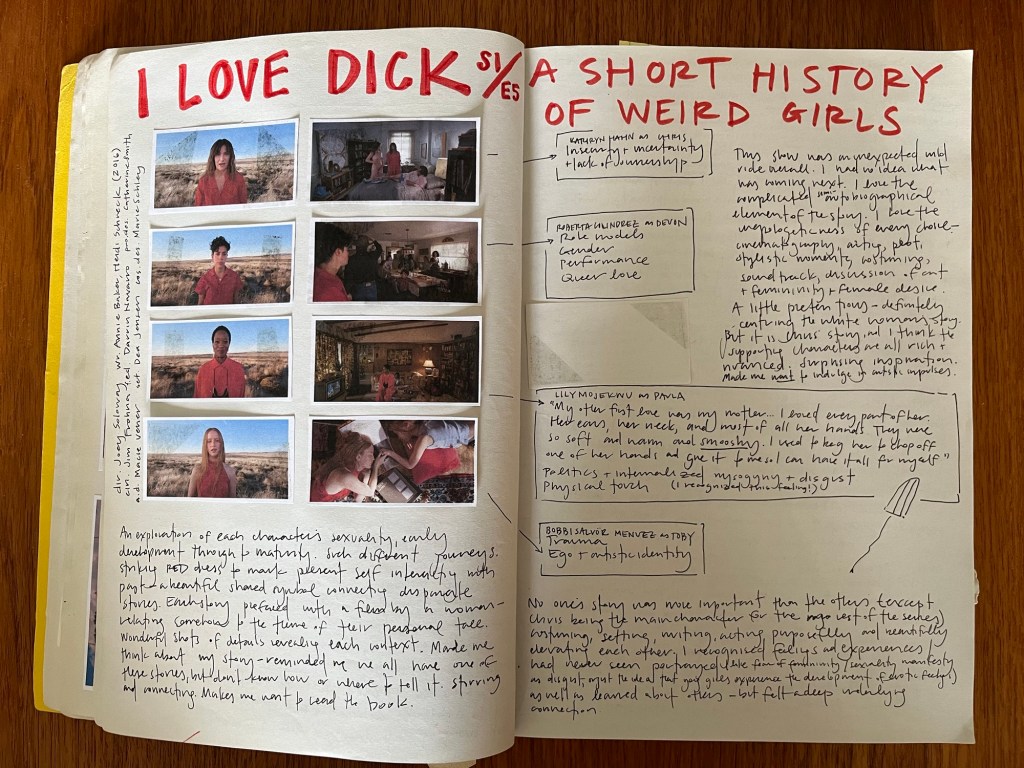
So far, I like the show better than the book. Joey Soloway, creator and adaptor, takes the book as inspiration and runs to the stark desert town of Marfa, Texas. We’re exposed to a landscape beyond Chris’ mind, her whiteness, straightness, and her big, empty house in upstate New York. She is still the central figure, but we meet other people in this place at the same time, with their own relationship to self and creativity. Their stories enable a more expansive exploration of art, gender, sexuality and community. I dedicated a page of my ideas notebook to Episode 5, A Short History of Weird Girls, a self-contained work in itself, maybe my favourite episode of television of all time.
But the show wouldn’t exist without the book. When it came out in 1997, it caused a stir. It entered the space of memoir and autobiography, but featured an unusual, raw level of self-exposure. It centred a woman owning her desire and objectifying a man. Real life Dick said it was a violation of his privacy.
I saw how it influenced semi/autobiographical work I watched around the time I watched the show: Radha Blank’s The Forty-Year-Old Version, Bo Burnham’s Inside, Michaela Coel’s I May Destroy You. And more recently: Richard Gadd’s Baby Reindeer. How do you reflect what is real in art? Do you state it plainly, fictionalise, or partly obscure? How do you include other people in your story? All these pieces of work have a different answer, and deserve their own unpacking, but the insistence on depicting selfish, messy selves was shaped by the boundaries Chris Kraus pushed.
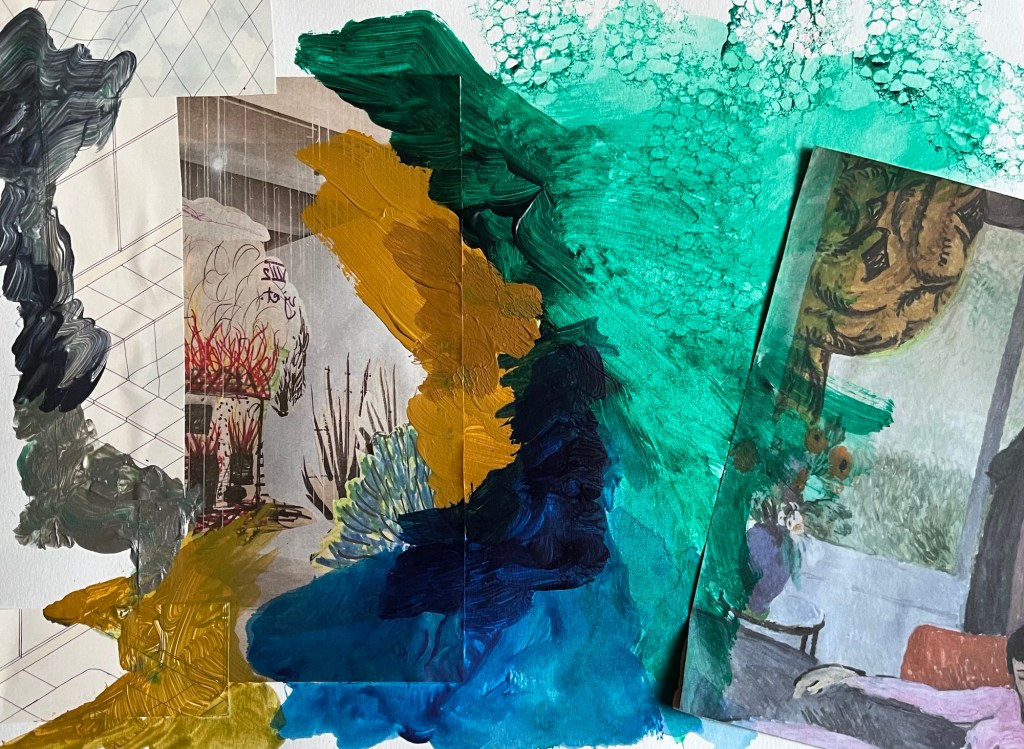
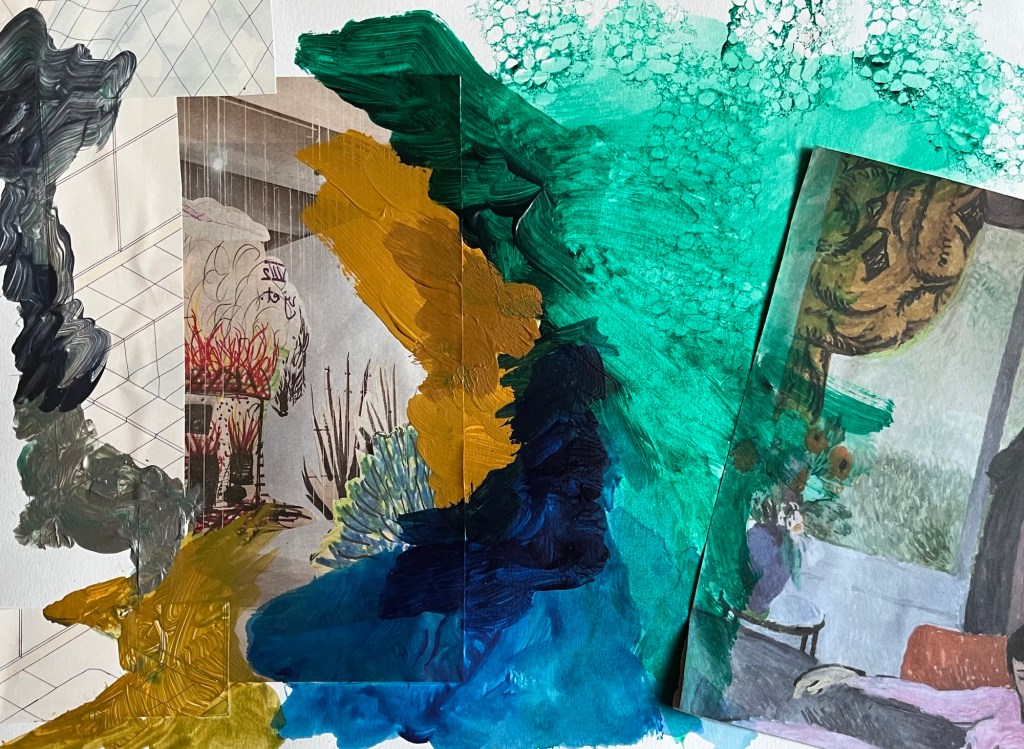
I went to the first in a series of four creative workshops today, run by an art therapist friend of a friend. It was a gently guided session, creating space for free-form mixed-media expression around a loose theme.
I worked with paint! I made harsh strokes, left it thick and gloopy on the paper. I picked images that I was drawn to. I didn’t question what I was doing, or think about it at all. It was liberating and joyful.
I do feel like all of this is doing something. Giving myself space to write, make, explore. Challenging the forces that have always held me back: fear, perfectionism, indecisiveness. Following my impulses and rejecting my inner critic. I just have to keep moving through it. As soon as I stop, the voices will return and convince me this is poorly conceived and self-indulgent.
9 July
Every detail matters. I want to write about everything.
The wet pavement as I walk to a friend’s house. Luna’s tan legs, kicking in the sling. The fluffy dog with its head in a cone waiting for its owner on the exercise machine in the park. The paved track around Mayow Park, where I must have walked marathons alongside the buggies, slings and child-wielding devices of other new parents.
This friend, a new friend, a friend of a friend, happens to live on the other end of my road and has a baby three months younger than mine. She has invited me to Latino Bambino, a salsa class where you wear your baby. It’s £2 and free if you need it to be.
It’s the last class at the community centre where it’s been offered for the last 13 years. The instructor tells us that the first babies who came are now teenagers. We meet another mum who brought her previous two kids, and now has her tiny third (and FINAL) six-week-old strapped to her chest. Everyone in the circle gushes about what it has meant to them.
Luna falls asleep shortly after we arrive and takes a nap in our new friend’s buggy. The instructor hands out maracas to dexterous babies, and starts the music. We move our hips, keep our torsos straight, follow the steps. The other babies bounce along to the beat, while Luna dreams and I have a personal salsa class. I haven’t loosened my body this way in a long time. I’ve done yoga since Luna was born, but slow, deliberate poses stretch and strengthen in a different way. My hips are slightly sore and I can’t quite put the arms and legs together, but I love the music and movement. Luna wakes up as we start the warm-down, which involves waving colourful scarves while we dance. She watches dozily and skeptically from the sling.
Afterwards, the instructor passes around the email of the council member to write to about keeping the classes going at the subsidised rate. She asks us to be specific if we can. We talk about the benefits for physical health, mental health, socialising, sensory stimulation for the baby. It’s affordable with visible concessions for anyone who needs them—many baby classes are upwards of £15 per session. The council do run some excellent, free activities for babies. But everyone agrees, this is really for the adults. I want to fight for Latino Bambino. I vow to write a thoughtful email.
The two of us stay chatting with the mum of three, who, as it happens, also used to live on our road and circle Mayow Park with her newborns. We exchange numbers.
Back at home, Luna and I play with blocks, look in the mirror, read some books. I make hummus just to do something else. It’s quick, I usually have all the ingredients and it’s one of the only things I feel confident to wing. I throw in a tin of chickpeas, two garlic cloves, a spoonful of tahini, half a lemon of lemon juice, a splash of olive oil, a sprinkle of salt, a few shakes of paprika. Luna sits in her kitchen spot (a mat and some pillows on the floor) and plays with her kitchen toys (some blocks, a spatula, and an expired National Art Pass card). It’s Tuesday.
 Junk Drawer
Leave a comment