
Plane
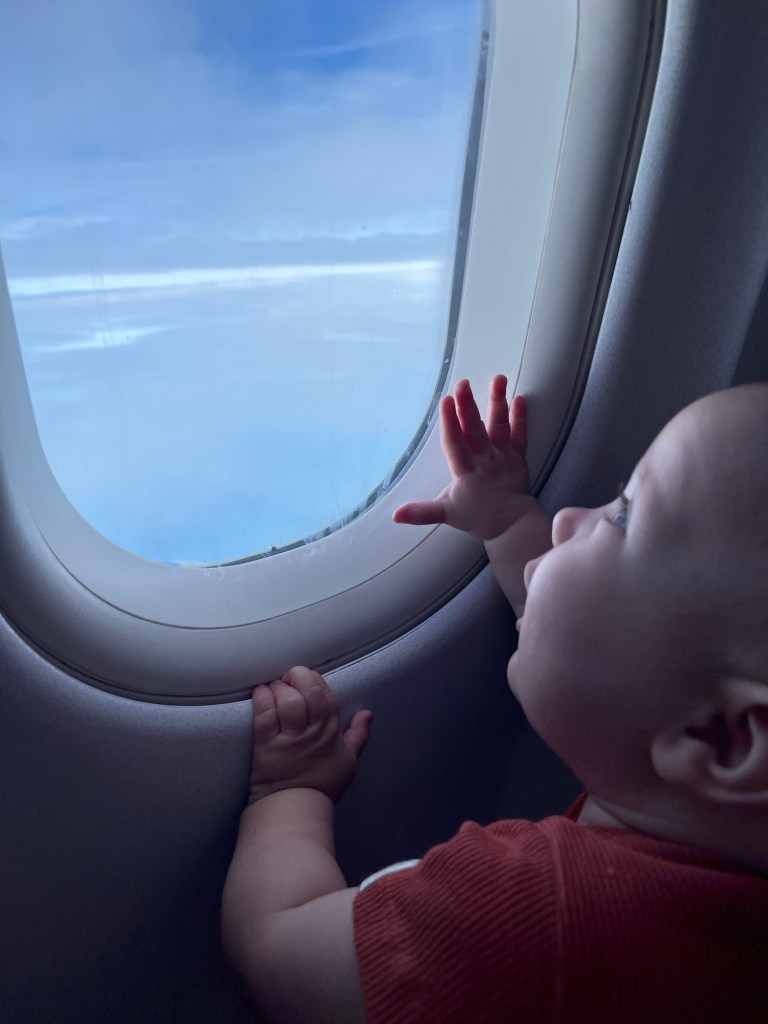
I wake up to blue on all sides, interrupted by small, craggy pieces of land.
I often find flights collapse my sense of time and place. Distance is either gone too quickly, or scrambled by back-to-back movies and short bursts of sitting-up sleep. But in this expanse of sea and sky, passing silly little specks of land, time and place are synchronised. It feels like we are moving across the planet.
Ragged cliffs and mossy mountains float in the clouds until their full form comes into focus, then slides out of view. Of course monsters and Gods were born here.
I nibble on the milk chocolate digestives we receive as a plane snack, getting crumbs on Luna’s head while she feeds.

We’re going to Lindos, a small town on the Greek island of Rhodes. My mother-in-law is turning 60 and taking the family back to the setting of many early Walker holidays and much family lore.
I start to read my holiday book, Outline by Rachel Cusk, which begins on a flight. I chose this book because the narrator is teaching a creative writing class in Athens over one hot summer. When traveling, I try to read a book about or by an author from the place I’m visiting. Plus I’m thinking a lot about writing and the cover image is a shell in the sand. It is pleasing to picture myself reading it on a beach.
Beach
The first time we took Luna to the beach, she was two months old. She mostly napped and then cried when I held her feet in the sand for too long. But that was the Pacific Ocean. This is the Mediterranean Sea.
We walk to Pallas Beach, a bay around the corner from the main Lindos Beach. It’s a sweet, sandy crescent down a steep, paved hill serviced by a row of beachside restaurants and two convenience stores.

We find a spot near the paddle boat vendor, who alongside the classic model, offers elaborate flamingo and unicorn-shaped varieties with slide feature. We claim five sun beds. This is a luxurious betrayal of our usual towel-on-sand selves, but the baby needs shade and they do offer more back support.
Luna flaps excitedly looking out at the water, her cheeks red and glistening in the heat. She shrieks in delight as I place her feet in the warm sand.

The water is cool at first but quickly feels refreshing. Luna is happy to enter up to her belly, then starts to complain. Daniel acclimates her “Dad style,” by bobbing up and down, inching incrementally further into the water with each dunk. This is the first time the wider family is seeing her swim, so everyone takes photos and enjoys the novelty of watching her splash.
An unspoken rota of care forms. Everyone takes a turn entertaining Luna and then passes her on for their personal beach time.


I lay out in the sun, take a dip in the water, move to the shade to breastfeed. Sun, splash, read, feed.

We eat lunch at the last restaurant in the row. I’m drawn to the tables laid out across several naturally occurring rocky platforms facing the water. The waiter put us at a table towards the back, but I request a table higher up and closer to the edge. This exposes a tantalising rocky cove tucked away from the sandy bay, aquamarine water whispering to me. If I was a mermaid, this is where I would live. I make a mental note to return.

After lunch, Granny buys Luna a tiger floatie, and everyone resumes their shift work.

I go for a swim on my own. I walk into the sea until the water reaches my shoulders. I look down at the sun fracturing against the water against my legs. My peach toenail polish blends into the sandy seafloor. I look up and see the big beach in the distance, sun beds densely crowding the sand, people filling in the gaps. I’m happy we are tucked into our little bay here. I submerge and emerge in place and then in forward motion. I feel the rush of water on my skin and in my ears, then the relief of air and sun on my face.
I return to my book. The heat is melting the glue binding it together and pages fall out as I turn them. I enjoy the simple descriptions of nothing really happening, which is the kind of writing I’m doing at the moment.
I look out at the rest of the family, now surrounding Luna in her aquatic throne. They call to her, gesture, peekaboo, itsy bitsy spider, zoom her around. She looks between them, with her eyes narrow and cheeks puffy, grinning. She shapes the family as the family shapes her.
Eventually, it feels like the right time to pack up our tote bags and buggy and walk up the steep hill home.

Pool
We take the bus to Pefkos, a necessary pilgrimage for the family. This was the town they were frequently based on their sacred two weeks away each year.
We walk down the high street as they point out the shop of the “you touch, you buy” lady, or where Dad rented a car and immediately backed into a wall.
I’m a visitor to these memories. I’m well-steeped in the family mythology, but from a distance. I could tell you the stories but wasn’t there when it happened. Now I’m here, in the place where it happened, wrapped up in nostalgia for holidays I never attended and a version of the family I was never a part of.
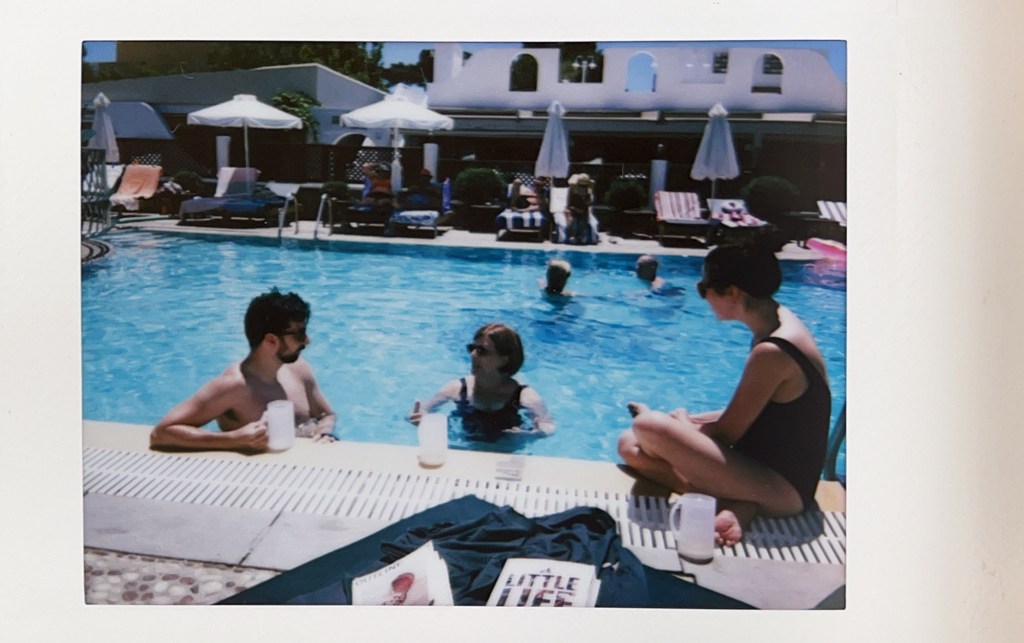
Our destination is the pool where The Evil Doers formed, a club made up of Mike and Zoe. The reason for the name is not my story to tell. We arrive at Oasis Pool and Snack Bar, next to Mr Ball’s Meze Restaurant. The water is neon blue and fluorescent pool toys float gently around. When we arrive, a middle-aged woman is in the water hugging a red noodle, staring blankly ahead. Ten or so other permanently pink over-60s flank the pool on their holiday towel-lined sun beds. The scene seems untouched since 2006.

Mike delivers beers in chilled, plastic mugs. Luna shows off some tricks from swim class, then gets tired and fussy. I feed her in the shade while I read my book and drink my cold Mythos. Her eyelids close and I savour her wet body tucked into mine. I put her down in the pram and try to continue reading, but get pulled into the family gossip happening poolside. We find new ways to talk about old news. Sip, dunk, giggle. Dad brings crisps from the shop across the street. Luna snoozes. I feel the buzz from a beer in the sun on an empty stomach.
The soundtrack to this scene is a playlist of crowd pleasers. We eat lunch to Time After Time. James Blunt’s You’re Beautiful comes on and a bald Greek man wearing a Grumpy Git t-shirt loudly sings along, then shouts “I’m telling you you’re beautiful and you say nothing!” The crispy, tipsy crowd is pleased.
For the rest of the afternoon, we rotate positions in and out of the pool, scootching sunbeds in and out of the shade. Red noodle lady never leaves the pool. Daniel and Zoe pass a volleyball back and forth and I see their thirteen and eleven year-old selves surrounded by the same characters, same Grumpy Git. The playlist starts to repeat itself. We leave this portal and its residents suspended in time for another 20 years.

Posh Cabanas
On Sheila’s actual birthday, we go to St Paul’s Bay, a smaller beach monopolised by one business who rent sun beds and run a restaurant.
This bay is dramatically framed by the acropolis on the hill looking over Lindos. The water is somehow clearer and brighter than Pallas—a rainbow of cool tones, yellow to green to blue.

Today, Zoe, Daniel and I treat Mum to a posh cabana, and we order some Greek sparkling wine.


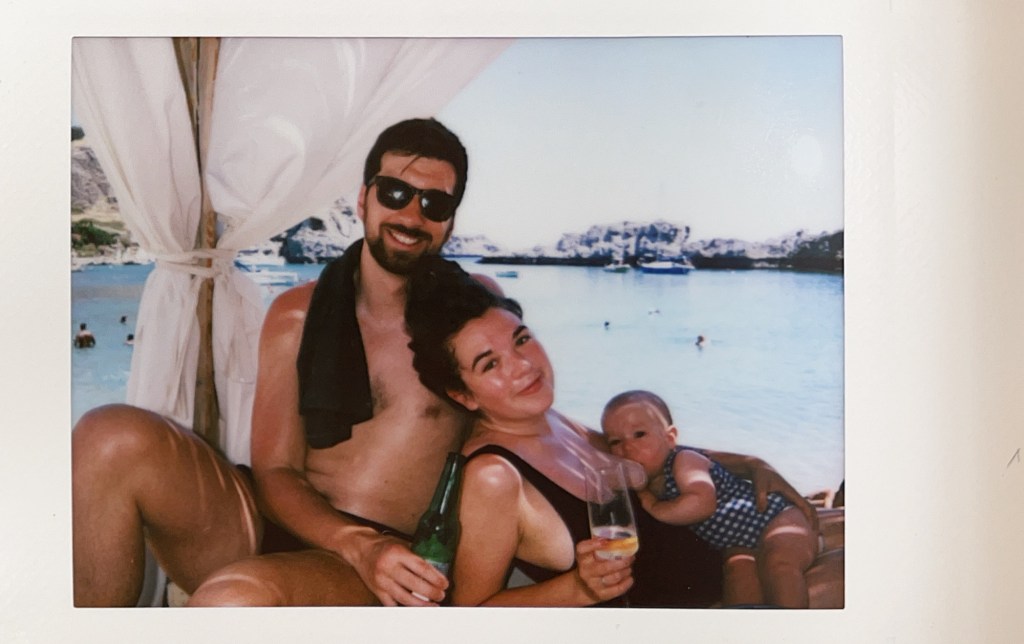
Daniel goes for a long swim and Mike lays out on a sun bed behind us with his headphones in.
Sheila, Zoe and I sip our bubbles and lounge against the postcard picture created by the wooden frame of the cabana. We talk about how families keep in touch. We order another bottle. Luna will be having tomatoes and formula for lunch.
When I go for a swim, this sand is more pebbly, and I have to wade in more tentatively, dodging sharp and spiky rocks. The bay spills into the sea just beyond a large cliff with a tiny white church on top. I am a tiny body floating in a much bigger body.
Daniel makes the hot trek home to make a bottle but Luna won’t take it right now. Her cries pull me out of my head and out of the water, and take us all back home.


Acropolis
Daniel and I wake up early one morning to walk up to the acropolis. I wanted to bring Luna in the sling, but Grandad was excited to look after her, thinly veiling his anxiety about her on the slippery steps. But Daniel and I haven’t spent any time alone together on this trip, so I was happy for the opportunity. We pass the shopkeepers opening up for the day, Kalimera, Good Morning. I was ready for a climb, but it’s a fairly straightforward walk up some stony steps, save a few grit-your-teeth edges with no railings.
We pass through a well-preserved stone entryway to enter the site. There are only a few other people around. Where the sun fans out across the water, it’s the same colour as the white morning sky. A hazy band of blue along the horizon is the only thing separating the two. There is an eerie, mystical peace to this place.

I walk to the side facing the water where there’s a low wall before a long drop. I feel queasy and can’t look over the edge. I find a higher wall. It looks like the Gods dropped gallons of blue food colouring into the water. It turns the yellow rocks green just below the surface. I hop between rocks and ruins to the side of the hill facing the town. The mess of stacked, white edges are tucked dramatically into the curvy, gray rock of the island. Water and sky balance and soften the picture, as if a painter perfectly calibrated the contrast.


I walk amongst the ancient things and imagine people existing here through time. I read the information on placards dotted around and immediately forget it. My brain doesn’t cling to dates, battles, and empires in the way Daniel’s does. He reads each explanation carefully, adding it to his internal encyclopaedia. I do enjoy the occasional passive aggressive comment made against Italians. One opening line reads: “Despite the positive aesthetic result that the Italian restoration works achieved on the acropolis of Lindos, it soon became apparent that it was catastrophic for the ancient monuments”

As we exit, a long queue of grumpy tourists has formed along the stone steps up to the entryway. We walk past, feeling smug: “How do we always do this?” I stubbornly insist I would have been happy to bring Luna, but it’s probably for the best, and I’m grateful we got this morning to ourselves.
On the walk down, the view is almost more dramatic. From between sparse trees, the town seems to jump forward like a pop-up book.

We sit and have a coffee and orange juice on a roof terrace playing a club remix of Bittersweet Symphony. We are mostly quiet, a little tired, lost in thought as we look over Lindos. We notice two goats on a faraway hill, surveying their kingdom too.

SIL Night
Zoe and I go to a wine bar I spotted down a side street a few days earlier with an inviting balcony.
As the waiter guides us up the stairs, I trip up the final one, bashing my big toe into the rock and slicing it open. I laugh through the unexpected pain and ask if he happens to have a band aid.
He returns with an improvised first aid kit, including a bottle of antiseptic spray. He insists on spritzing my toe himself and puts on the band aid. As I wipe the blood from my Birkenstock, I wonder if this foreshadows a chaotic night ahead.
We ask the waiter to recommend one of the orange wines and he asks where we’re from. He seems genuinely baffled by our answer and asks how an American and Scottish girl end up here. “I married her brother, we’re on a family holiday, her brother is at home with our baby and we’re drinking wine!”
He brings us our bottle and pours one glass “for the Hurt Girl” and another “for the Scottish Girl”. He must have been starved of chat that day because he frequently comes over to top up our still-full glasses and ask us a question, always very politely beginning “If I may ask…”
We learn that his name is Alexius and he’s from Thessaloniki, on the mainland. We talk about wine, working in hospitality, how Lindos is different than his hometown, and living in a place geared mostly toward tourists. Then we reach a natural pause and he says “well, I’ll let you two enjoy!” and Zoe and I dive back into our conversation. It slowly gets dark as we gradually drain the bottle and cackle and conspire into the night. I never know what time it is.
Later on, a group of four men arrive—the only other party on the balcony. We order a bottle of Pet Nat during a break in their conversation. “Is that an American accent I hear?” asks the leader of the group, a man with deliberate-looking windswept hair and three buttons of his shirt undone.
I say yes, he asks where in the US, and I’m ready with my script: I grew up moving around, so I have the accent, but haven’t lived there for very many years. He asks Zoe the same, and she’s ready with hers.
He asks what we do. “I’m a scientist,” Zoe answers. He probes, and she laughs to herself as she tries to describe technical research terms to these men at a bar. “And you?” he nods to me. “I manage a theatre” “Ah, so we have the arts and sciences here today!” and says something suggesting their inherent rivalry. I reply something along the lines of, “they are often placed in opposition but they really need each other.”
It emerges that he is the owner of this bar. The other three men at the table are employees from his other business, plus Alexius, plus Claudia, the other member of staff and only other woman who has come to sit down and join the conversation. We are now talking about his management philosophy: “I am their employer, but I am not their boss”. I am instantly wary of this contradictory statement: “I understand the sentiment, but think that it’s important to be aware of power dynamics. When you pretend there isn’t a power imbalance you’re more likely to abuse your power” “I would never abuse my power! Let me give you an example…” Long pause. “…Alexander the Great!” He launches into a story about how Alex fought side by side with his army, and when they were thirsty “he poured his own flask out for his men”.
“And when have you poured your flask out for your men?” I ask. Another long pause. Alexius comes to his rescue and says “he’s a great teacher”
We are done with the Pet Nat and ask if we can get a bottle to go. Alexander the Great thanks us for our wide-ranging and fascinating conversation. Our wine thoughts decide he is at best obnoxious, at worst extremely toxic.
I reveal my idea for what’s next: night swimming. We wander down the now quiet winding streets, all the shops and restaurants closed. The water is an inky black pool next to white sun beds and collapsed umbrellas that glow in the light of street lamps lining the slope down to the beach. We leave our clothes and wine on a sun bed and run naked into the chilly water. We swim and chat in the dark water under bright stars. I don’t know how long we stay, but I get out of the water to pee twice over the course of our swim and scare a group of teenagers away with my never ending, postpartum stream. We stay under the surface until we’re shivering.
Plane home
And then we’re on a runway taking off again, flying over the dense, green side of the island into the blue tunnel. We pass the other islands, a trail of dropped stones collected from the beach. This time I notice the huge masses of land that continue just under the water after the shoreline cuts off into the sea.
As we gain elevation, I feel the trip exiting the present and crystallising into memory. I can’t know which details have already been left behind next to our nearly-finished bottles of sunscreen and whatever else we’ll only realise once we don’t have it back home.
Luna arrived in Greece with two teeth and has departed with four. Her hair is thicker and body longer. She has started clearly mimicking sounds and movement: a wave hello, da da da da, ba ba ba ba, ma ma ma ma, and blowing raspberries.

While I have the same number of teeth, I depart Greece imperceptibly different than when I arrived.


 Junk Drawer
Leave a comment